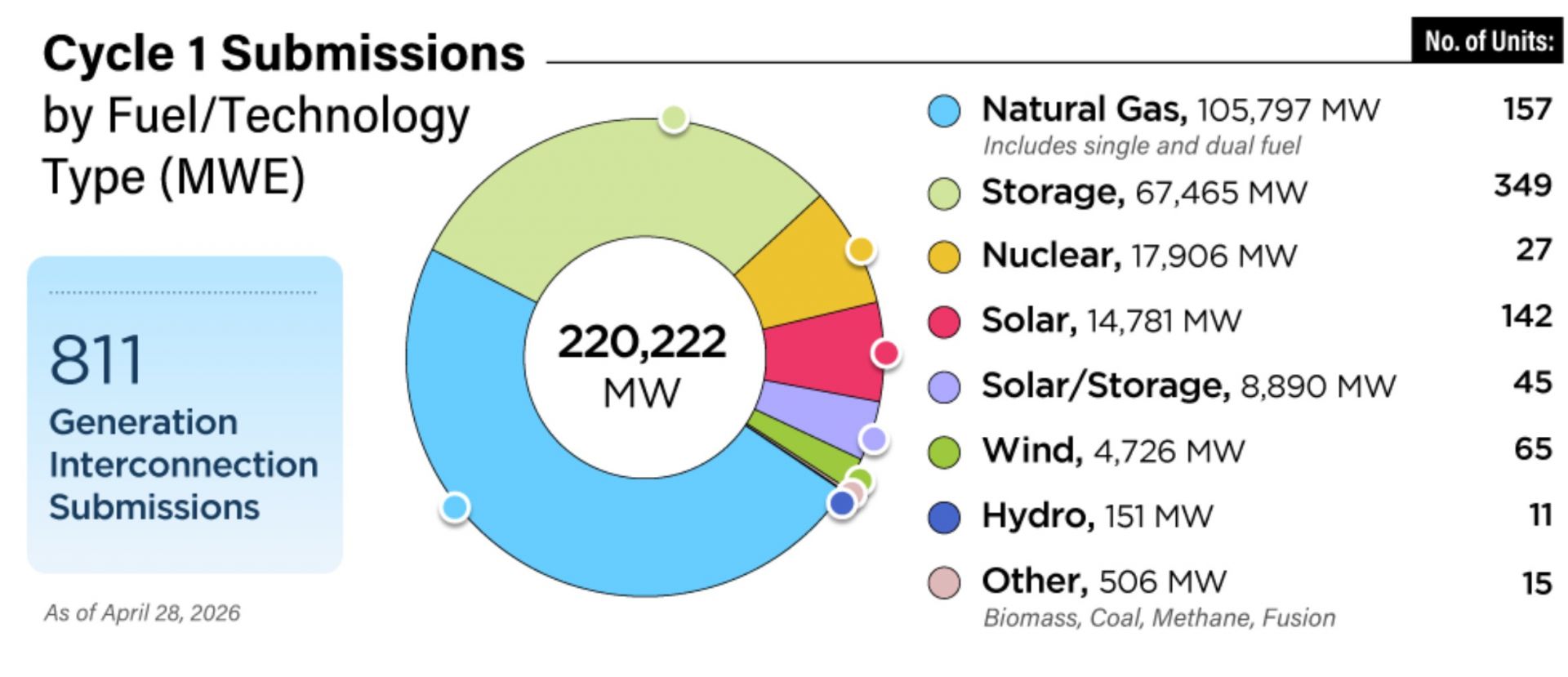
A bold step into fusion’s long horizon: PJM’s massive interconnection queue reveals how a single fusion project sits among hundreds of conventional plans, and why the industry’s timelines feel both surreal and increasingly plausible. Personally, I think this moment marks a pivot point where rhetoric about fusion meets the practical demands of grid planning, vetted by a contemporary toolkit that includes AI-assisted data review. What makes this particular move interesting is not just that a fusion project has entered the interconnection queue, but that it’s positioned within a broader system overhaul aimed at speeding approvals while safeguarding reliability.
Pushing a fusion project into the queue changes the narrative around near-term power infrastructure. One thing that immediately stands out is the sheer scale: 811 projects totaling 220 gigawatts, with 17.9 gigawatts classified as nuclear—yet only one is fusion, tagged as “other.” This contrast highlights how fusion remains the fringe inhabitant of a grid modernization landscape dominated by traditional, established technologies. From my perspective, the presence of fusion in this mix signals willingness to consider non-traditional sources alongside fission benchmarks, not as an exotic anomaly but as part of a diversified long-term strategy. It’s a reminder that the grid’s evolution will require negotiating between existing physics, regulatory hurdles, and the upside of revolutionary energy sources.
The interconnection process itself has been redesigned to move projects through faster and safer approvals. PJM’s leadership claims an AI-enabled tool helps sift through large volumes of technical and financial data. What this suggests is a new normal: the grid operator is leaning into machine-assisted validation to reduce bottlenecks without compromising systemic integrity. From my vantage point, this is more than just tech tinkering; it’s a cultural shift in project governance. If you take a step back and think about it, the AI layer is a form of risk management—triaging projects by complexity, cost, and grid impact so that the most viable entrants rise to the top more efficiently. The deeper takeaway is that AI isn’t replacing human judgment; it’s accelerating it, enabling engineers to devote more time to engineering questions rather than paperwork.
For CFS, the fusion project under the ARC program, the initial queue entry is both an achievement and a bridge. It buys time, signals intent, and triggers a cascade of assessments intended to validate grid compatibility. Yet the reality is that being in the queue does not equal a green light. The next phases involve deep engineering studies and potential network upgrades, with the grid’s reliability at stake. My view is that this is where the real testing ground lies: can a fusion plant, with magnetic confinement technology, be evaluated, financed, and built in a system trained on conventional generation timelines? The nuance here is that ARC’s commercial fusion approach isn’t just about “getting to power”; it’s about proving a new category of project management that blends novel physics with mature infrastructure constraints.
The strategic context matters. Crane’s restart—Three Mile Island-1’s revival pathway—exemplifies the tension between ambitious reactor projects and the grid’s readiness to absorb new capacity. Constellation’s aspiration to restart Crane soon contrasts with PJM’s projected grid-connection window, possibly as late as 2031. In my opinion, this juxtaposition underscores a broader truth: the grid’s timing and the physics of a project don’t always align. The takeaway is not gloom but a lesson in sequencing—how early project designation and front-loaded studies can prevent later grid-connection bottlenecks, even if the actual commissioning drags. What many people don’t realize is that the interconnection queue functions as a strategic staging area: it’s where hopeful reactors and renewables are tested against the grid’s capacity to absorb new, sometimes disruptive, sources.
The ARC project’s near-term milestones—groundbreaking in 2028 near Richmond, Virginia, and subsequent scaling toward thousands of plants—represent a long arc of ambition. The broader implication is that fusion’s path to utility-scale deployment will be gradual, marked by iterative demonstrations (like SPARC achieving Q>1) before a commercial cascade can unfold. From my perspective, the most intriguing element is the implicit confidence that a validated, scalable model exists: that fusion can progress from demonstration to commercialization in a way that complements, rather than competes with, existing baseload technologies. This raises deeper questions about how power grids should diversify, how regulators calibrate risk, and whether the public’s perception of fusion shifts from theoretical promise to tangible, distributed energy reality.
A deeper pattern emerges when you connect the dots: the interconnection queue is both a gatekeeper and a blueprint. It filters projects through a lens of technical feasibility and financial viability while revealing which ideas are serious bets on the grid’s future architecture. If you step back, you can see how this process could shape not only when fusion enters service, but how it changes project economics, supply chains, and policy priorities. A detail I find especially interesting is that fusion’s entry into this process could spur a new ecosystem of specialized engineering firms, regulatory pilots, and private financing aligned with long-horizon energy missions. What this really suggests is that fusion, once a distant prospect, is becoming a regular player in strategic grid planning—albeit still in the cautious, capability-building phase.
In conclusion, the PJM interconnection filing is more than a visibility marker for a single fusion project. It’s a case study in how a modern electricity system negotiates risk, timelines, and disruptive technology. The practical path forward remains steep: complete SPARC’s demonstration, validate ARC’s design at scale, secure the necessary grid upgrades, and align financing with multi-decade horizons. Yet the overarching message is encouraging: the grid is evolving to accommodate audacious ideas, and fusion is quietly being folded into the infrastructure playbook. If we’re honest, that is exactly the kind of patient, disciplined optimism we need to keep energy innovation from stalling. What this means for the public is a quieter but persistent promise: a future where cleaner, abundant fusion power is not a myth but a measurable, contributing part of the energy mix.